Arch-Enemy Vertov
Arch-Enemy Vertov, 2025
Synopsis
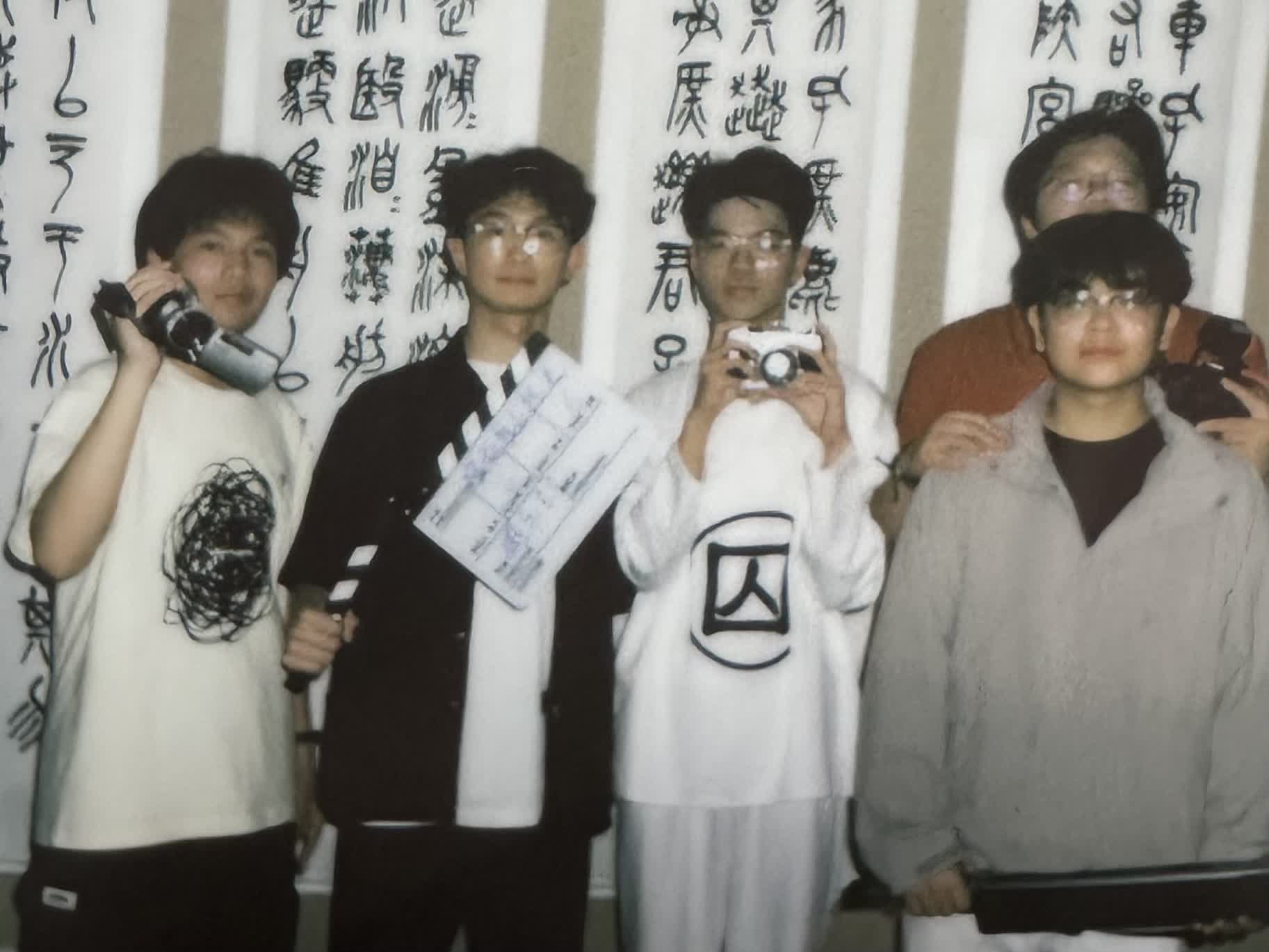
Arch-Enemy Vertov follows three photographers who appear to share the same profession but inhabit entirely different relationships with images.
Vitin and Funeiri carry cameras with them, continuously searching for things to photograph. One chases scenery, while the other records what he encounters. Eset, by contrast, calls himself a photographer despite owning no camera. Rather than capturing the landscape, he simply looks at it.
As the three move through the mountain, photography gradually becomes less a profession than a way of perceiving the world. Images accumulate, cameras continue to operate, and an unseen ghost repeatedly appears to kill the two men who remain attached to their cameras.
At the end, film and memory cards are placed beside a photograph of Eset. He discards both recording media and keeps only the photograph of himself.
The film ends with a question:
Who killed them?
Director’s note
I wrote Arch-Enemy Vertov in 2025, nine months after making Sealed with a Kiss. It was the first film for which I wrote the screenplay entirely by myself.
The idea began while I was travelling.
I noticed how frequently people encountered a landscape through their phones or cameras. A beautiful view appeared, and almost instinctively, a device was raised. The moment was photographed, stored, perhaps uploaded to social media, and then often forgotten.
I began to wonder whether the desire to preserve an experience could actually weaken the experience itself.
This thought led me to Dziga Vertov and his idea of the “Kino-Eye.” What interested me was not simply Vertov as a historical filmmaker, but the conceptual proximity he created between the human eye and the camera.
I wanted to resist that equivalence.
For me, the eye and the camera do not perform the same act.
A camera records. An eye experiences.
This opposition became the starting point of the film and eventually gave it its title. Vertov became a kind of conceptual “arch-enemy”: not because I wanted to attack him personally or reject his entire body of work, but because his idea offered me something against which I could define my own position.
Vitin and Funeiri are deliberately not opposites. Although one photographs weddings and the other photographs funerals, their difference is partly comic and superficial. Both remain dependent on the camera.
Eset is the actual contrast.
He claims to be a photographer while possessing no camera because, for him, photography begins with looking.
At the same time, I did not want the film to function as an illustrated essay whose symbols could be translated into one correct interpretation. The ghost, the photographs, the discarded film and memory card, and the repetition of death are therefore left open.
The film began with a personal belief, but I would rather allow the images to exceed my explanation of them.
Production notes
Arch-Enemy Vertov was conceived and produced within approximately one month during my first year of high school in 2025.
The production involved three actors, two additional crew members and myself. I worked as director, producer, cinematographer and editor. The entire film was shot in one day on a mountain inside a public park.
My two previous films had already taught me an important practical lesson: with extremely limited time, people and equipment, I could not convincingly imitate the smooth visual and technical language of an industrial film production.
Rather than continuing to treat this limitation purely as a problem, I decided to incorporate it into the film itself.
For the shoot, I used a Sony DV camcorder manufactured in 2008, which I had bought in Fuzhou. Instead of pursuing technical cleanliness, high resolution or conventional cinematic polish, I became interested in the texture produced by an older consumer camera.
Storyboards, shot planning and blocking were prepared beforehand. However, as I had already discovered on earlier productions, plans inevitably changed once the actual shoot began.
Time remained the main limitation. Although the production was considerably smoother than my previous two films, a single day still left little opportunity to refine every frame as carefully as I wanted.
Nevertheless, this project marked an important change in my production process. Technical imperfection was no longer something I was only trying to hide.
For the first time, I began asking whether limitation itself could become form.
Reflection
Looking back, Arch-Enemy Vertov feels like the first film in which I began to recognise my own authorship.
My first two projects were primarily concerned with making a film successfully. I worried about whether the story could be completed, whether the camera work looked professional, whether the performances worked, and whether the finished result resembled what I understood a “proper film” to be.
With Arch-Enemy Vertov, that standard began to change.
I realised that constantly measuring my work against industrial filmmaking was not particularly useful. I did not have an industrial crew, professional lighting, extensive rehearsal time or multiple shooting days. If I continued trying to imitate those conditions, the result would almost always appear to be an incomplete version of something else.
Instead, I began to ask whether those deficiencies could be absorbed into a coherent visual language.
The old DV camera became central to this shift. Its image did not look polished, and I did not want it to. The editing did not attempt to produce the invisible continuity associated with conventional commercial filmmaking. Discontinuity, roughness and visual instability could become part of the film’s identity rather than evidence that the film had failed to become something more professional.
This does not mean that I am completely satisfied with the result.
If I could return to the production, I would spend considerably more time refining the images. The shoot was still compressed into a single day, and there are frames I now feel could have been composed, repeated or developed more carefully.
But this time, dissatisfaction with individual images does not make me reject the film as a whole.
What matters to me is that I began to understand the difference between imperfection and intention.
A technically imperfect image can still belong to a deliberate aesthetic system.
That discovery was more important to me than technical improvement alone.
What I learned
The most important thing I learned from Arch-Enemy Vertov was that filmmaking does not have to begin with the question:
“How can I make this look more professional?”
It can begin with another question:
“What kind of image do I actually believe in?”
My previous films had taught me about preparation, scheduling, storyboarding and blocking. Those lessons remained important, and I applied them more consciously on this production.
But Arch-Enemy Vertov taught me something different.
It taught me that limitations can become artistic decisions.
A small crew, an old camera, imperfect continuity and limited production time do not automatically need to be disguised. If they are understood and controlled, they can become part of the language of the work.
I also learned that film could function for me as a way of thinking rather than merely a way of illustrating a story.
The characters in this film are not only people within a narrative. They embody different relationships with seeing, recording and remembering. Their actions allowed me to explore an idea without turning the film into a direct explanation of that idea.
Most importantly, this was the first project in which I felt that I was beginning to develop authorship.
I was no longer only learning how to make films.
I was beginning to decide what I wanted a film to be.