Sealed with a Kiss
Upon the River O, 2026
Synopsis
Sealed with a Kiss is a school comedy built around a chain of misunderstandings, unspoken feelings, and misplaced confidence.
When Zhengzheng accidentally discovers a love letter written by Qilian to her close friend Xizi, jealousy and uncertainty lead her to interfere. What begins as a private misunderstanding soon expands as their friends step in, each believing they understand what is happening and each trying, in their own way, to help.
Letters are misread, messages are delivered to the wrong people, intentions are assumed rather than explained, and relationships gradually become entangled in a situation that none of the characters fully understands.
Beneath its romantic premise, the film is less concerned with love itself than with what happens when people remain silent, act on incomplete information, and mistake assumption for understanding. The result is a deliberately absurd chain reaction in which almost everyone believes they are making the situation clearer while actually making it worse
Director’s note
Sealed with a Kiss was written entirely by my friend Qiushui, who had also written my first film, The Wrong Move. My role in the project was as director and producer.
What first attracted me to the screenplay was not its identity as a school romance, but its structure of misunderstanding. Almost every character acts according to what they think they know. Instead of communicating directly, they observe, interpret, speculate and intervene. Each decision creates another layer of confusion.
The Chinese title, Yi Wen Feng Jian, contains this contradiction. “Kiss” suggests romance, while “jian” refers to sealing or silence. For me, that silence became the more interesting part of the film: affection exists everywhere, yet genuine communication is almost absent.
Looking back now, I can also see other ideas inside the story that I did not fully understand when I first directed it—the possessiveness of unrequited love, jealousy, and the way friends can interfere in other people’s relationships while believing that they are helping.
Still, I do not want to reinterpret the film entirely through what I know today. At the time, what fascinated me most was much simpler: the comic absurdity created when people refuse to speak clearly and become increasingly confident in their own misunderstandings.
Production notes
Planning for Sealed with a Kiss began shortly after the production of The Wrong Move and continued for roughly eight months. We eventually shot the film in October 2024, shortly after I entered high school. It was my second formal filmmaking project.
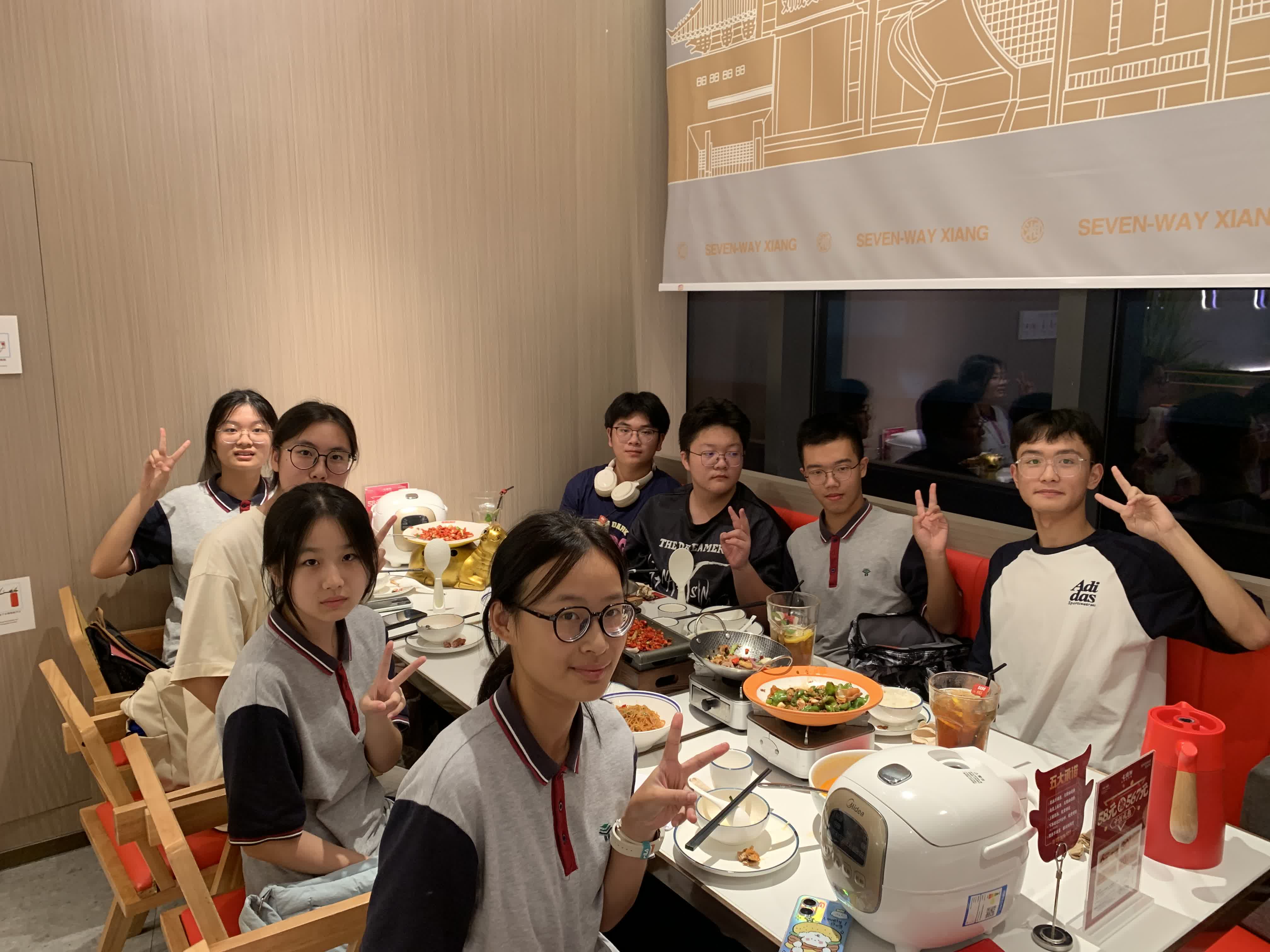
The production consisted of six actors and myself, making it larger than my first film. However, the entire film had to be shot within a single day during China’s National Day holiday.
Although I had already moved on to high school, we returned to my former middle school for the shoot. The screenplay had been written while we were still students there, and I felt that returning to the original environment was important. There was also a practical reason: my high school was preparing for its 40th anniversary and its spaces were unavailable.
We entered the middle school during the holiday without arranging a formal production. During the shoot, we happened to meet a vice-principal and a teacher. After a brief conversation, they simply reminded us to stay safe and allowed us to continue.
Technically, the production was actually more limited than my previous film. The Wrong Move had been shot on a Sony A7 IV, while Sealed with a Kiss was filmed primarily with a DJI Osmo Pocket 3. Its built-in stabilisation meant that I did not use a separate gimbal, but we also had almost no dedicated lighting or sound equipment.
The greatest limitation, however, was not the camera. It was time.
The screenplay contained considerably more scenes, characters and camera setups than my first film, yet we had only one day in which everyone was available. As a result, our priority gradually shifted from making each scene good to simply making sure that every scene existed.
There was little opportunity for rehearsals, actor preparation, lighting refinement or repeated takes. In many cases, once a shot technically worked, we had to move on.
The film was ultimately never completed in post-production.
Reflection
I never finished Sealed with a Kiss, and for a long time I felt embarrassed by that.
I tend to be perfectionistic about my own work, and when I looked at the footage, I saw almost exclusively what had failed: the rushed performances, the lack of controlled lighting, the underdeveloped production design, and a visual quality that did not match what I had imagined while preparing the film. I was also dissatisfied with the ending of the screenplay.
For a long time, this made the project feel like something I would rather hide than include in a portfolio.
Looking back, however, I think its incompleteness is part of why the film matters to me.
It was the first time I tried to handle a story significantly more complex than my production resources allowed. Instead of a relatively small narrative, I was now dealing with six performers, multiple locations within a school, intersecting character perspectives, letters, fantasies, flashbacks and parallel misunderstandings.
The failure was therefore not simply that individual shots were poorly executed. The more important problem was the gap between the ambition of the screenplay and the conditions of production.
I had underestimated how much time filmmaking requires before the camera even starts recording. Actors need time to become comfortable with one another. Blocking has to be tested. A scene often has to be repeated before its rhythm begins to feel natural. Lighting, framing and performance cannot always be solved simultaneously under pressure.
We had prepared storyboards and thought about staging in advance, but the schedule became so compressed that many of those preparations could not meaningfully be used.
At the same time, one aspect of the project still interests me deeply: its structure. I remain fascinated by stories in which the same situation can be understood differently depending on whose perspective we occupy. If I return to this kind of film in the future, I would like to explore shifting viewpoints more deliberately and with far greater control.
I no longer see Sealed with a Kiss simply as an unfinished film. I see it as the project that revealed the distance between imagining a film and actually producing one.
What I learned
The most important thing I learned from Sealed with a Kiss was that time is not merely a logistical condition of filmmaking. It directly affects the quality of almost every creative decision.
Before this project, I tended to think that preparation mainly meant having a screenplay, knowing the story and planning shots. This production taught me that a storyboard is only useful when the schedule gives you enough time to execute it.
I also began to understand the importance of blocking. With more characters and more complicated interactions, simply placing the camera in front of the actors was no longer enough. Their movement, position, timing and relationship to the space all needed to be designed.
Most importantly, I realised that actors need time.
Especially when working with non-professional performers, it is unrealistic to expect everyone to arrive, immediately understand one another, enter their characters and deliver their best performances. A production needs room for conversation, rehearsal, experimentation and even simple social interaction before filming begins.
On Sealed with a Kiss, we had almost none of that. Because we were racing against the clock, “finished” repeatedly became more important than “good.”
That experience changed the way I think about production. A more ambitious screenplay does not automatically create a better film. The scale of a project has to match the time, people, equipment and attention available to make it.
And sometimes, doing less gives a director the freedom to do it properly.